
Dialectica: Debugging the World’s Information
Our relationship with truth has always been pixelated. Advanced societies across history have blended mechanical fact-finding with moralized ordeals, like trial-by-drowning.
Today, social platforms reward speed and reach. A post that is wrong loses nothing; a correction gains little attention. Over time this creates a backlog of contested “facts” that linger in policy debates, markets, and public opinion but never truly close.
How Dialectica Changes That
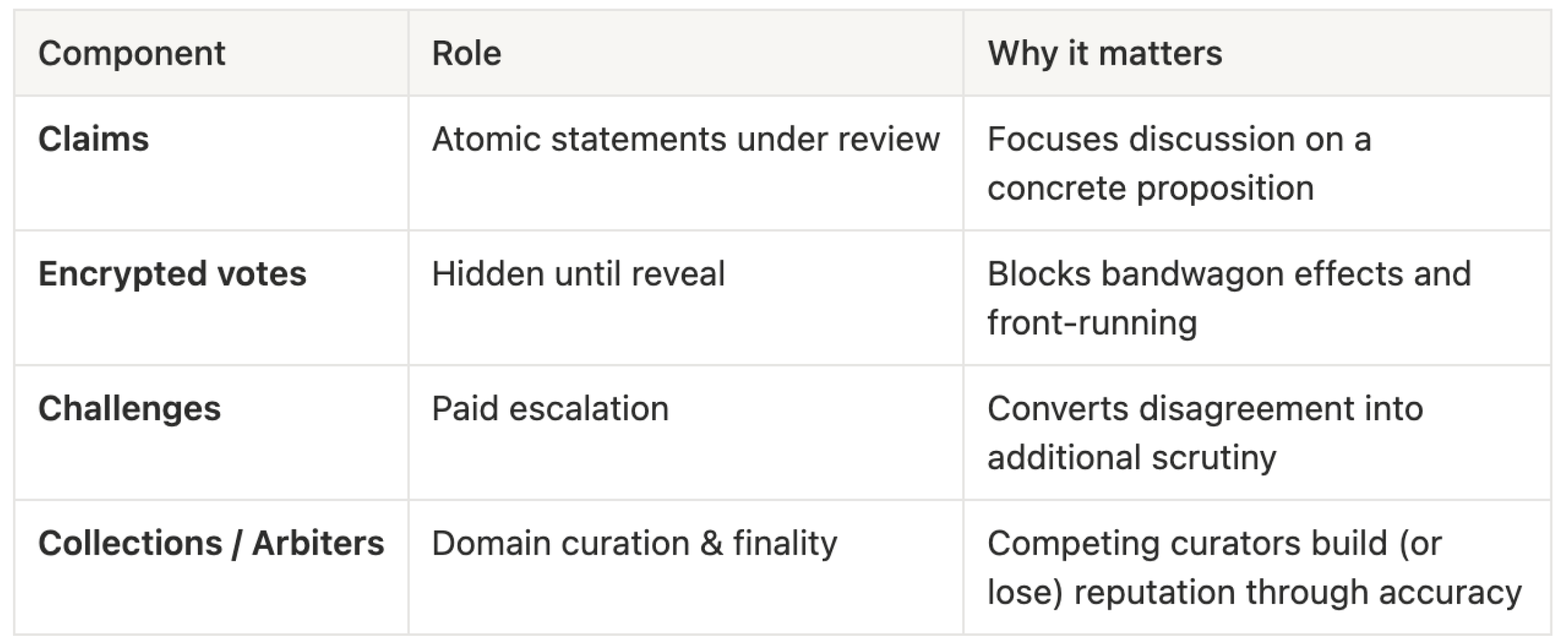
Dialectica lets anyone publish a claim (e.g., “DPRK leader Kim Jong Un does poop”) and invite wagers on True or False using encrypted votes.
Results are revealed only after the round ends, limiting herding and last-second sniping.
If the outcome looks wrong, a participant can post a challenge bounty to open the next round.
Escalations continue until a preset depth, after which a collection-appointed arbiter makes the final call.
Core Components
Expected Participation Pattern
- Humans identify contentious topics and create or stake on claims.
- Research bots, via the public API, gather evidence, place encrypted votes, and auto-challenge shaky results.
The design assumes most heavy verification will migrate to automation while people decide what is worth examining.

What a Resolved Claim Looks Like
- Round 1: $10 on True, $4 on False → settles True.
- A challenger posts a bounty; Round 2: $40 on True, $55 on False → settles False.
- No further challenge occurs; claim closes as False, Round 2 bettors share the pot, challenger bounty returned.
Cost, Risk, and Current Status
Dialectica is an unaudited alpha on Base. It carries smart-contract, oracle, and economic risks; users should treat any stake as experimental capital.
Why This Matters
When being wrong costs money and being right is rewarded, due diligence becomes rational again. Dialectica does not replace discussion; it adds a mechanism to finish it.


